


Love Philly? So do we. Let’s be friends. Sign up for the Billy Penn newsletter today.
A surprise update on the battle over waste incineration emerged from City Council’s budget debates this week, along with some teases about future trash-management initiatives — a public composting pilot, an exploration of waste “digesters,” 100 more cameras to detect illegal dumping, and the revival of a free trash can program.
The updates came as City Council works its way through Mayor Cherelle Parker’s $6.97 billion budget proposal for the fiscal year that starts July 1. The plan represents a 1.9% increase over the budget for the current year that council approved last June.
Council has been holding a series of hearings since Parker released her proposal on March 12. Sessions have focused on spending on parks, libraries, human services, the mayor’s office, and other departments, and on the city’s long-term fiscal outlook.
Upcoming hearings will review the police and fire budgets and funding for SEPTA and arts programs. Additional sessions are scheduled through April and into early May. The budget must be passed by the end of June.
A surprise one-year extension
Councilmember Jamie Gauthier has been trying to get the city to stop burning trash. Currently it sends 40% of its trash to incinerators, principally the Reworld (formerly Covanta) waste-to-energy facility in Chester. She cites the air pollution impacts on Chester residents, and calls the burning of trash in the majority-Black city an example of environmental racism.
Last year, Gauthier authored a bill that would bar Philadelphia from contracting with any incinerators. The Parker administration opposes the measure, and it’s unclear when it might come up for a vote. Officials have said taking the waste to landfills instead would cost an additional $6 million a year.
At a hearing Tuesday, Gauthier said the city’s 7-year contract with Reworld expires June 30 and would have to be renewed by then.
“If we do not pick another partner or alternative, we’ll be in another seven-year contract with Reworld, which is not only the largest incinerator in the country, it’s the largest industrial polluter in the region,” she said. “So the timeline for that would be past the [end of the] Parker administration.”
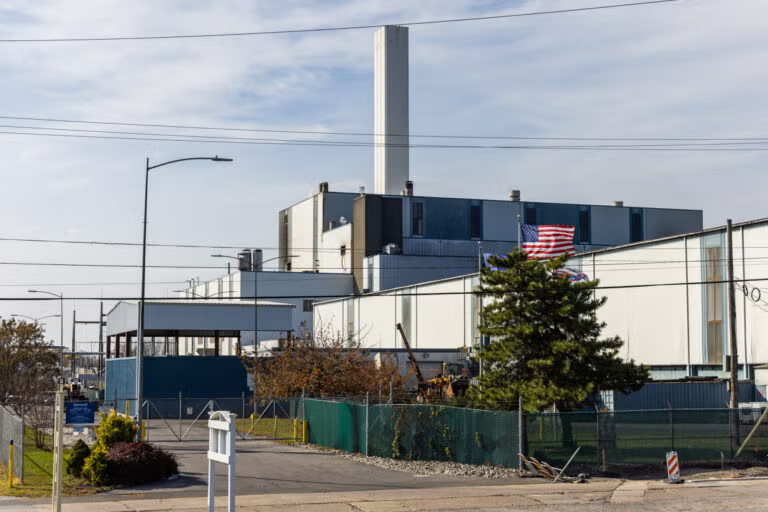
Carlton Williams, the director of Clean & Green Initiatives, clarified that the new contract would be for four years, with a three-year renewal option. He also mentioned that the city has requested a one-year extension of the current contract with Reworld, which appeared to take Gauthier and other councilmembers by surprise.
“It’s the first time I’m hearing you requested an extension,” Gauthier said.
“I would just ask that you come to the table a little more directly,” added Councilmember Rue Landau, a co-sponsor of the bill. “If you asked for a one-year extension of the contract, you could have started right there.”
The city’s Law Department subsequently said the city has not yet asked Reworld for a one-year extension. Such an extension could give the city time to arrange a switch to other disposal methods without requiring a longer commitment to the incinerator.
Gauthier and Williams cited studies about the harms and benefits of the incineration, and Williams said the Streets Department has hired two firms, MSW Consultants and Civil & Environmental Consultants, to evaluate different disposal options.
A city composting program, at last?
The discussion touched on broader questions of how to reduce the amount of trash the city needs to dispose of, and what kind of work is being done to come up with alternatives to incineration and landfills.
Williams said organics like kitchen and yard waste makes up 30% to 40% of the city’s waste stream. Finding different ways to manage those materials, along with increased recycling, could eventually help the city get to the point where it diverts 60% to 70% of its trash away from conventional disposal methods, he said.
Sanitation commissioner Crystal Jacobs Shipman said the city will pilot a “small organics program that will help residents remove the materials that are in their home.” The department will work with council “to make sure that those locations are known, where people can drop off their material and how it will be utilized from there,” she said.

The organic materials will be collected using the city’s existing network of Big Belly public trash and recycling receptacles, spokesperson Keisha McCarty said. It will initially include 10 locations and require residents to download a phone app to participate, in an effort to help keep contamination of the sites to a minimum, she said.
Sanitation officials have floated the idea of a residential composting program in the past, but the proposed pilot would be the first to be implemented. Last year, for example, Clean & Green Initiative officials had said they were planning to launch a subscription-based drop-off program.
The Department of Parks & Recreation has for several years had a program to compost food waste from recreation centers, and the agency’s Farm Philly urban agriculture program oversees a network of 23 community gardens and other sites where residents can take food and yard waste for composting.
Shipman also said the city is trying to boost its low recycling rate — only 14% of recyclable materials are recycled, well below the national rate of 32% — in part through educational programs in schools.
More public trash cans and cameras
In other trash-related news, Shipman said her department is rolling out a pilot called PhilaCan 2.0. It’s a new version of a free trash can distribution program that initially launched in a section of North Philadelphia in 2018, and has at times been open to residents in other neighborhoods.
The program “will allow for larger cans for both recycling and trash. For folks who don’t have the ability to store the trash in the back of the home, if your block is selected, you would be able to store that can outside. Other folks would be able to utilize it, if that’s the appropriate use for that particular can,” she said.
Williams noted that some residents don’t like having outdoor trash cans on their block, and participation in the program would have to be approved by the block as a whole.

Separately, the department has a Community Cans program that allows community organization and business districts to place wire basket trash receptacles outside in commercial corridors.
Other initiatives under way include the installation of more Big Belly receptacles, primarily on commercial corridors. The city currently has 1,200 sets of cans in several neighborhoods and plans to install 300 more, Shipman said.
Some critics describe the Big Bellies as nuisances that attract dumping, but city officials have said demand for the cans from residents and community organizations remains high.
Shipman also said her department also plans to install 100 more surveillance cameras in illegal dumping hotspots in addition to the 400 already in place. The city uses those cameras, and others controlled by the Police Department and other agencies, to spot dumped materials and do investigations to identify and fine offenders.
In the future, the city would like to use artificial intelligence systems that can “catch people in the act” of dumping and immediately notify law enforcement, rather than just providing footage for investigations after the fact, Williams said.


