


Love Philly? So do we. Let’s be friends. Sign up for the Billy Penn newsletter today.
Birthday celebrations can be fraught the older you get — especially the big ones. Not only do you have to come up with a good party idea and get a bunch of people to show up, but suddenly the day becomes an evaluation on how your life is going: are you where you want to be?
The same can be said of the United States’ 250th birthday party.
America’s “semiquincentennial” — a word you may not have known before 2026, but keeps cropping up in the city’s marketing materials — is taking place all summer. Restaurants, bars, museums and even casinos are throwing their America 250-branded bashes with custom hats, specialty cocktails and t-shirts.
Comcast is sponsoring a party. Walmart is sponsoring a party. Wawa is sponsoring a party. The World Cup — a global soccer tournament that the majority of Americans have historically tuned out of — is now getting tied in with the ultimate American bash.
“What’s been interesting to me is how many types of events can masquerade as 250 celebrations,” said Emma Hart, an early American history professor at the University of Pennsylvania. “I’m actually going to the World Cup on July the fourth… It’s going to be France versus Germany if it all goes according to form, which is definitely not very American.”

Hart has been subscribed to and following planning emails for national America 250 celebrations. History, she said, can be subjective — and the Trump administration’s focus on 250 parties often takes a simplistic approach to understanding our country’s founding.
“The version of the 250 that’s coming through, is the version of American history that is obviously closely honed to the current administration’s view,” she said. “Which is wholly celebratory and focuses very much on the Founding Fathers who, you know, rightfully are celebrated as having a major role in the event.”
“There’s no doubt that what they did was incredible in its time,” she said, but also noted that this was a version of events that eschews nuance.
And yet, with all the buzz — are Philadelphians actually that excited about America 250, or are we just celebrating out of obligation? Reflecting on the last 250 years, is the country where it wants to be?
Are you excited for America 250?
National news has been tinged with doom and gloom this year with headlines like “Life, Liberty and the Pursuit of Unhappiness” from the New York Times, or “Public Anger Is Rising” from the Atlantic.
Americans are facing rising inflation, higher utility bills, ICE raids, AI and technological disruption, a war with Iran, among other national headlines in 2026.
We headed to Washington Square Park in historic Philadelphia to take the temperature on sentiments around America 250.
“I am not feeling overly celebratory when I consider America in the current age,” Jesse Peirce, a local nurse, who lives in the area, said. “I would love to remember that there are so many positive elements to both this country and more so to its people, but I think that can be overshadowed by what’s currently happening politically and socially.”
Peirce is one of a handful of Philadelphians we chatted with who wasn’t feeling positive about celebrating America’s 250th birthday, even during such a big milestone year.
“I’ve seen ICE agents, even in this park,” she said. “It’s disheartening.”
Philadelphia artist and rapper Sharif Lacey, known for his stage name Reef the Lost Cauze, had similar feelings to Peirce. He was afraid that the celebrations might ring a little tone deaf — especially for residents of color.
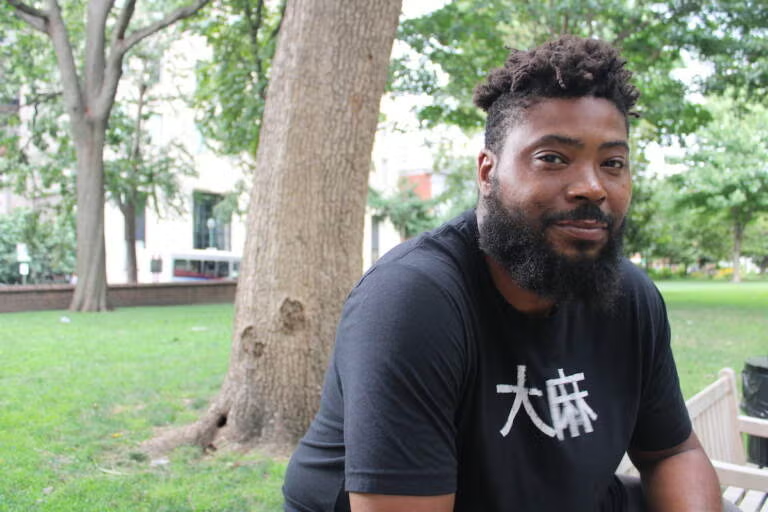
“I feel as though for myself and people that look like me, there’s nothing really to celebrate,” Lacey said. “The promise of America, the ideals of America, the belief of America has always kind of been an illusion — always been something that’s kind of eluded us… What we’re seeing happening all over this country, as far as Black and brown people are concerned, I would find it very understandable and very relatable for anyone that didn’t feel like they were a part of the party, so to speak.”
“It’s kind of like people having a picnic in the park, enjoying themselves, and you’re looking from the outside in,” he added.
Some Philadelphians we ran into weren’t even aware that an America 250 celebration was taking place.
“I know nothing about America 250,” Veronica Philipsborn, a Fairmount resident who works in criminal defense, said. “I wasn’t even aware that there were celebrations happening.”
The only 250 event she had heard of was the 2026 FIFA World Cup. However, she was not “particularly excited about” the upcoming fan fest on Lemon Hill.

“I think it’s such a beautiful community space, and they only invested into it because of this FIFA thing,” Philipsborn said. “That’s going to cater to outsiders and non-Philadelphians, and I think at the end of the World Cup viewing, the park is just going to be kind of left a mess, and I really hope they take care of it and make it nice for residents.”
For their part, fan fest organizers have pledged to install the permanent infrastructure upgrades and park enhancements to improve Lemon Hill following the World Cup.
What should a 250 celebration look like?
Not everyone we ran into believed that America 250 festivities needed to be a big reckoning on our country’s faults, but rather hoped for a celebration of our nation’s ideals.
Cynthia Murray, VP of sales and marketing at the Bottle Shop in Spring Lake at the Jersey Shore, came to Philadelphia for a special trip with a friend. The pair had just visited the Museum of the American Revolution and were dressed in a full red, white and blue get-up.
“I’m feeling really excited about it, and really proud to be an American,” Murray said. “It’s such a great opportunity to visit Philadelphia in this important year.”
“We just saw the Liberty Bell,” she said. “We’re here in this beautiful Independence Park. It’s so nice here. It’s such a walkable city. You can really feel the history as you’re walking the steps that Ben Franklin took.”

For Murray, taking the time to celebrate what is good and working about our country does not have to be a bad thing. After all, when we celebrate our own birthdays, we don’t publicly drudge up our flaws and mistakes.
“I think that’s a shame,” she said of people who aren’t feeling the hype. “As Americans, we should be proud of being Americans, and we have to take the good with the bad, and people have different political views… We have to look back and see how we started and how far we have come and how we will continue to grow and change. In life, there are differences, but at the end of the day, we are all Americans, and I really feel strongly about that, and very proud of being an American.”
For residents like Lacey, however, questioning the state of the country and pushing against where we are coming up short is a way to commemorate America 250.
“I guess in the literal sense, we’re celebrating independence, you know, defecting from Britain and all that jazz, and the birth of a nation — no pun intended,” Lacey said. “But I think we really need to question what that nation has become. What that nation will become, moving into the future. So, it’s a double-edged sword. I had a grandfather that fought in World War II, and you know, I definitely wouldn’t want to be anything but an American. I just wish America felt the same way about me.”
“Nations are complicated and not entirely positive”
Seth Bruggeman, a history professor at Temple University, said that it can be hard for administrations to force a wholly celebratory picture of our nation — especially in today’s digital age.
“The difficulty with celebrations like the 250, really any of the centennial celebrations we’ve had, is that they seek to organize how we think about the past around stories of accomplishment and progress and achievement,” Bruggeman said. “And that’s fine, and those are good things and they all exist within the American saga. But as you and I and anybody who’s ever lived for a moment anywhere knows, stories about nations are complicated and not entirely positive.”
Philadelphia has a long history of celebrating the country on big birthday occasions. America’s Centennial party in 1876 took place in Philadelphia, and became our country’s first World’s Fair. Planners built Memorial Hall in Fairmount Park (now the Please Touch Museum) for the occasion and attracted nearly 10 million visitors.

Still, while Bruggeman noted that the public loved that celebration, it was far from a perfect time in our country. The Centennial took place about a decade after the Civil War and came on the heels of the Financial Panic of 1873. What’s more, the celebration itself largely catered to white men.
Bruggeman cited the 1984 book “All the World’s a Fair” by Robert Rydell, which speaks to the racial and gender disparities at the Centennial.
According to Rydell, the event was deeply shaped by racial and gender tensions. Black construction workers and contractors were largely excluded from jobs to build the fair.
Frederick Douglass “suffered humiliation,” as police initially barred him from sitting with other dignitaries. Women had to fight to be included, and were permitted a separate pavilion. Then, Black women, who helped raise money for the event, weren’t allowed to participate.
Rydell quotes Miss R. Cole, a Black activist, in the book.
“It was then, and not till then,” Miss R. Cole said, “that I had any idea that our work was to be confined exclusively among our own color, and that we were to have no voice nor to form any part of the local committee in the wards.”
The country’s bicentennial celebration in 1976 was also mired in political conflict. The nation was recovering from the Vietnam War and the Watergate scandal. In Philadelphia, civil rights groups pushed back against the Rizzo administration and protested the celebrations.

“I don’t know that there’s ever a moment where America is just doing perfectly well,” Bruggeman said. He added that national celebrations that don’t embrace nuance or leave out certain groups, like the Centennial celebration, have been met with diminishing returns.
“My big concern is that we don’t also whitewash our current moment,” Bruggeman said. “We have to see the complexity, and we have to make sure that when we remember, we do it in a way that acknowledges and affirms the struggles that all Americans face.”
Museums, art and America 250
While many America 250 parties feel like corporate sponsorships, Professor Hart believes that there are local institutions working to take a more comprehensive approach when it comes to the semiquincentennial.
“I think in Philadelphia exhibitions — like the Museum of the American Revolution’s ‘Declaration’s Journey’ exhibition — you see a very nuanced version of America, in which 1776 was the beginning of a journey towards equality that we’re still on,” Hart said.
She pointed to the Trump administration’s recent involvement in taking down the slavery exhibit at the Presidents’ House as a clear point in that ongoing journey.
“I think we’re at this point, where people at the local level are doing what they want to do, and people at the federal level are doing what they want to do,” Hart said.

Bruggeman also pointed to the slavery exhibit at the President’s House as an important moment in our 250th year.
“I am 100% absolutely opposed to the president intervening in the historical work of the National Park Service,” he said. “On the other hand, I would never want to take a position that says the historical work of the National Park Service is unflawed and should remain absent of critique, right? It’s the critique, it’s the conversation, it’s the pushing and pulling, it’s the challenging of what we think about the past, not just its affirmation, but the challenging of it. That is really what doing history is all about.”
Even local museums, he warned, cannot give the full picture.
In addition to historical exhibits, art museums are curating shows that aim to reflect a more complicated view of the American legacy.
Mural Arts is putting on printmaking workshops asking the question, “What does freedom require today?” Smaller galleries around the city are presenting shows hoping to tackle a more full picture of the semiquincentennial.
InLiquid’s upcoming Future/Past/Present, for example, focuses on “erased histories” and “reimagined American iconography.” The Philadelphia Museum of Art and the Pennsylvania Academy of the Fine Arts are showing “A Nation of Artists,” which looks at the evolution of American art, including works from Black, Indigenous, immigrant and historically underrepresented artists.

“We don’t pretend to have the whole national story, because every museum is unique,” Kathleen Foster, senior curator of American art at the PMA, told WHYY News. “We’re very strong on a local, regional story. We’ve tried as much as we can to open it up to tell a more national story, to include Indigenous voices, to include artists from the South and from the West. But the truth is, there is no museum that is encyclopedic.”
Perhaps there is no perfect way to celebrate America’s 250th, but for Lacey, his ideal celebration is one that embraces our country’s flaws.
“America really is about revolution and revolutionaries, and people that were not afraid to speak up to make things change,” he said. “Everything that we see, everything that we have, everything that’s become possible is from people that died or put their blood, sweat and tears into making those changes. I would want to celebrate them, because those are the people that really are what America is about to me.”


