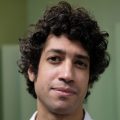
Previously Ramona Susan’s Bake Shop, 1424 South Street is now home to Avenida 7 Café, a cozy family-owned Cuban spot serving coffees, pastries, and breakfast and lunch specials.
There are, of course, croquetas, “an important food for everybody in Cuba,” owner Yosvan Barroso told Billy Penn. Available in single servings with a side of salsa rojada or bundled in a Sarcone’s roll, the croquettes are filled with ground ham and a spice blend, “as my grandma made when I was a young boy,” the 52-year-old said.

The same approach extends to the rest of the menu. No hot sauces are used, just sofrito. The fried chicken is flourless, marinated overnight in a mixture of onion, garlic, and cumin; the pork similarly soaked in naranja agria and various spices. They’re both options for the congri rice and fried plantain platters, along with a beef ropa vieja.
Arguably less traditional —“it was created in Miami, by Cuban citizens of course” — but still earning a spot on the café’s menu, the Cuban sandwich is a substantial stretch of ham, roast pork, pickles, mustard, and Swiss cheese. Beef and veggie burgers are available, and, recently on the specials list, a Cuban cheesesteak. “We made it in a Cuban way, using pork” mixed in with the beef, Barroso said.
Pastries like croissants, donuts, and polvorones, and desserts like Cuban flan and tres leches cakes are made daily. A variety of Pilon ground coffee drinks are also available iced, a preference that Barroso admitted he found baffling upon moving to the US last year.

It’s all about finding a balance, “but trying to preserve the Cuban sense,” he said. “We prepare everything here as [we did back] home.”
For the Barroso family, home, until recently, was the small Cuban town once known as Hershey.
Founded in 1916 by the American chocolatier 60 miles east of Havana, Hershey, Cuba was modeled on its Dauphin County counterpart. The town featured a public school, movie theater, baseball stadium, and 160 homes for the families working at Hershey’s adjacent sugar refinery and plantation, set up to bolster milk chocolate production due to shortages caused by an ongoing world war. To service his factory’s production line, Hershey also built an electric railway system — the nation’s first — extending beyond Havana.
Since 1959, the town has been officially known as Camilo Cienfuegos, after the Cuban revolutionary and close friend of Fidel Castro who had died that year. For Barroso, his hometown will always be Hershey.
“I [was] very proud to be living there,” he said of the place where he, his parents, and his children were all born, and where he had built a house for his family, at age 21, on Hershey’s Seventh Avenue.
It’s a hometown pride partially informed, Barroso said, by his admiration for the “great man” who founded it.
Three years before moving to the US and after almost 30 of working in government-owned factories — he as an engineer and she as an accountant, both underpaid — Yosvan and his wife Barbara decided to go into business for themselves. They rented commercial space from the government, a defunct neighborhood café where Yosvan would go for croquette sandwiches as a child. He resurrected the venue’s name, “El Alamo,” adding “Hershey” to its end and hanging old photos on its walls of the sugar refinery and the town’s more prosperous days; a “part of history that was forbidden for the people.”
When, Barroso said, the government inevitably called to ask why he was reviving an outdated name, “I responded, “because I live in Hershey.”” He continued to run El Alamo Hershey as he saw fit for about three years, with a staff of family members in increasingly Hershey-branded attire, and menu items like a chocolate sauce-drizzled burger.
It was during that time things became uncomfortable for Barroso’s youngest son, a recent journalism graduate whose writings had begun provoking the ire of government officials.
Eventually deciding to leave for the US through Nicaragua due to its lack of visa requirements for Cuban citizens, the younger son was detained at his national airport and told he’d be imprisoned if he returned. Traveling through South America, he made his way to Texas, where his older brother, a Manhattan-based lawyer, was waiting. Five months later, sponsorship papers came through for the parents, as well as their younger son’s wife and Yosvan’s 80-year-old mother, all settling in Philly.

With their initial plans for a food truck falling through due to logistical challenges, the Barrosos scouted the city for brick-and-mortar options, coming across Ramona Susan’s Bake Shop the day a “for rent” sign went up in its window. A deal was secured with financial assistance from their oldest son. His younger brother fills out his time off from his job, also at a law firm, by helping out at the café along with his wife.
“They’re doing for us now what we did for them before,” Barroso said of his sons, proudly.
The Barrosos still haven’t made it out to their hometown’s namesake. Eager to fulfill an invite from a customer whose father owns a farm in Hershey, they’ve so far been consumed with setting a steady pace for the café since opening in December, and fine-tuning things like optimal business hours.
“Sometimes we’re scared,” Barroso said of starting from scratch in their fifties in a new country. “But we are fighters, me and my wife. We’re always looking for hope, opening new horizons, because that’s the essence of life.”
1424 South Street | 10 a.m. to 7 p.m. daily (subject to change) | $3-$20 | (267) 398-2786