
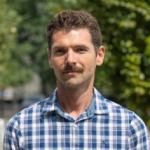

On a clear and chilly night along South Street, the pedestrians don’t know they’re being cased. As they go up and down the sidewalks bathed in a mix of street lights and moonlight, Brendan Happe is camped out looking for a mark.
“If you see people looking up at the sky, it’s going to be an easy sell,” Happe says with a confident glint in his eye.
Through his rounded glasses, he homes in on a couple coming down the street. Then he pounces.
“Wanna see the moon?” he asks them. “Sure, 100%,” one of them says. “That was an easy sell,” adds the other, inadvertently echoing Happe’s own words.
The sale made, Happe launches them, and whoever else is interested, on a tour of the cosmos by way of his curbside telescope. Gaze through the eyepiece and he takes you on a journey from the pavement to the planets.
Depending on the calendar, stops can include Jupiter, Saturn, or the brightest object in the night sky, the moon. There’s a theme to the responses from people lining up to look in the lens, whether it’s at the moon a couple hundred thousand miles above or one of the gas giants several hundred million miles away: “Whoa … that’s amazing” is the common refrain.
Setting up a telescope in the middle of a light-soaked urban jungle isn’t as crazy as it seems. What Happe is doing by bringing the observatory to the people along South Street is called “sidewalk astronomy.” As he tells it, the mission of his scope in the city orbits around “offering a view of the planets and the moon in order to share something that people aren’t going to stumble upon naturally.”
While he’s out there solo these days, Brendan Happe goes by “PhillyMoonMen” on social media. That’s because he started his quest to share views of the big white orb in the night sky with his brother Bill back in February of 2018. When he arrived to visit Bill in Philly, Brendan found him outside with a pair of binoculars. Grabbing them from his brother, Brendan scanned the sky, landed on the moon, and his life changed.
“Seeing the mountains and the craters on the moon with my own eyes – it was beautiful,” he said . “And I guess I thought to myself, ‘Wow, I can’t believe I’ve lived my entire life without ever seeing this.’ And I imagined that was the same case for most others, especially those who live in light-polluted places.”
That very first night, after taking in the topography of the moon, Brendan and Bill both started soliciting people to look at the heavens through the binoculars; the PhillyMoonMen were born.
The brothers gained a following and their amateur astronomy project grew, but like so many things, COVID put the kibosh on it. In 2021, Bill left for grad school in Europe, and Brendan went to the West Coast. After heeding the call of California, Brendan returned to Philadelphia in 2023.
“Like the very first night back in Philly, I brought my telescope to South Street and I looked at Venus, and I just kind of felt whole again,” he recalled.
It’s no accident one of the first things he trained his telescope on was Venus. The cloud-wrapped second planet from the sun outshines everything in the night sky except the moon. Even the lights of Center City can’t blot out the shimmering diamond in the morning and evening sky. However, they do a fantastic job rendering almost everything else invisible.
“The Comcast Tower is a glowstick, right up in the sky,” according to
Bill McGeeney, a dark sky advocate who works with the Pennsylvania chapter of the International Dark Sky Association.
While McGeeney lives in Philly, he’s not in the core of the city. Even a little distance from the hub of highrises and street lights makes for a deeper dark and richer sky.
“I live over in the Roxborough, East Falls area, and we have about a hundred stars on any given new moon you can see naked-eye,” McGeeney said. “From information I’ve heard from a fellow advocate who lives in South Philly, they count around thirty.”
That discrepancy can be attributed to light pollution – an untold number of bulbs or blinding LEDs blasting their brightness up to the heavens.
“It is, in a word, devastating,” said Ken Walczak. He’s with the Adler Planetarium in Chicago and has extensively studied light pollution, running multiple experiments with high altitude balloons at night to capture light emissions. He says publicly available data collected by satellites looking at darkness on the Earth only goes back about a decade.
“We’re only just beginning to know what losing our night is going to do to us and do to our world,” Walczak said.
When it comes to total light emission, he dove into the data and Philadelphia is about as bright as Denver overall. When you score emissions by area, it’s another Denver-Philly tie. Meanwhile, both LA and New York are more than 200% brighter than the City of Brotherly Love by both metrics. Chicago apparently has its high-beams on and is more than 300% brighter.
All that light turning the night sky a murky mauve is doing more than blotting out the view of the Milky Way.
“We’ve had four and a half billion years of evolution on Earth all entrained to a day-night, day-night, day-night cycle for that long, and then literally in less than 150 years we’ve lit up the night without much regard to its effects,” Walczak said.
While science and medicine work out just exactly what we’re doing to ourselves by erasing true night, the expert who works inside the planetarium believes setting up a telescope outside in the heart of a city offers something valuable.
“Sidewalk astronomers give you that opportunity to say ‘Wait, there’s something there,’” Walczak said. “And then you’re like, ‘Oh my God; what else am I missing?’”
That seems to be the sentiment along South Street as people peer through Brendan Happe’s telescope.
“This is neat,” said Charlie Silva after taking in the view. “This adds to my night, a lot, because you couldn’t expect it. And it’s so cool because I don’t think you get to see Jupiter every night.”
Although dinner with a friend beckoned, Lily Gardner was curious about the telescope on the sidewalk and stopped to see the view. After taking a peek, she was struck by the perspective it provided.
“I know when I look through it I get an existential kind of feeling or thoughts that are good to have,” Gardner said.
As for the PhillyMoonMan sharing the wonders of the sky, Brendan Happe may be in his late 20s, but he’s convinced he’ll be doing sidewalk astronomy for the long haul.
“I kind of already know that this is something that I always want to have as a part of my life,” he said with unflappable clarity.
Weather permitting and no clouds overhead, Happe says he’ll be on South Street most nights, keeping an eye out for inquisitive people and enticing them to just look up.


