


Love Philly? So do we. Let’s be friends. Sign up for the Billy Penn newsletter today.
Four years ago, Joey Essinger was doing well, by his own account. He was off dope, renting a house in Frankford, and getting plenty of contracting work — drywall, flooring, tile, electric, plumbing, and whatever else clients needed.
“I’m not a material person, but, like, I had a lot of material things,” he recalled. “I was making good money. I had money saved.”
He was still very much an addict, though.
“Sometimes the addicts, see, when we’re really down, and we go through things that are tough emotionally, we get high. And sometimes, we’re doing so great, it’s like, ‘we deserve to get high.’ And that’s kind of like where I was,” he said.
Essinger is 41 years old, short, with a boyish, bearded face and a scratchy, occasionally slurring voice. Originally from Barnegat Light, New Jersey, he lived in Miami for 13 years before moving to Philadelphia in 2019.

Three years ago, he lost everything when he returned to active heroin use — but then an unusual program helped him get out of homelessness and back into recovery.
Sitting in an office at Sacred Heart Recovery Residence in Hunting Park earlier this year, he described his quick descent back onto the street.
Using heroin once turned into using it twice, then every other day, then every day, he said. He burned through his rent money, got kicked out of the house he was renting and started sleeping on the streets near 30th Street, sneaking into the Amtrak station for a respite from the cold when he could.
He’d often visit Penn Presbyterian’s emergency room for issues like foot pain or a cold, or just to have a warm bed for the night. And the staff there remember him well.
“At least three times a month he would be there for, I would say more so minor things,” said Madison Schmus, a Penn Medicine nurse who often treated him. “He’s what we would call ‘a frequent flyer.’”
Twice a day Essinger would take the L to Kensington to buy and use drugs. He started having frequent seizures during withdrawal, and at one point suffered a minor stroke, he said. He entered drug treatment in late 2024, and the day after he got out, he got high again and took a hard fall at the Girard L station, shattering his right heel, he said.
An ambulance took him to Jefferson University Hospital, where doctors told him it was critical that he use a wheelchair for a few months.
“They’re like, ‘If you don’t stay off of it for at least 10 weeks, you’re gonna do damage to it. We’re not gonna be able to fix it. You’re never gonna walk right again for the rest of your life,’” he said. “I heard that, and I was like, that scared the heck out of me, you know?”
Limited access to recovery-centered housing
Stories like Essinger’s are achingly familiar to medical and shelter providers in Philadelphia who care for people who are living on the street and using opioids and other drugs.
Many are caught in a vicious cycle of homelessness and declining health. Their lives are too chaotic to allow consistent care, which often leads to worsening medical issues. In turn, challenges like poor mobility, slow-healing wounds, or the need for kidney dialysis make it very difficult to find suitable housing.
The Parker administration is spending hundreds of millions of dollars to create more shelter beds and operate a “wellness ecosystem” of drug treatment services and centers, and a variety of nonprofit and private organizations operate programs as well. But medically fragile people often can’t take advantage of that network of resources.
“If you’re, for example, in a wheelchair, there’s very limited options to access recovery-centered housing,” said Gilly Gehri, a project manager at Penn Medicine’s Center for Addiction Medicine and Policy. “If someone is on methadone, it’s really hard to access a skilled nursing facility. Or if someone doesn’t have a dedicated dialysis chair — there’s just so many barriers.”
Instead, those individuals essentially remain homeless between disconnected episodes of medical care.
People end up bouncing “back and forth to the hospital, bouncing between hospitals and recovery houses, or skilled nursing facilities and rehabs,” said Rosa Friedman, a medical case manager at Penn. For those patients, that results in “a lot of turmoil, because of these systems not really having the resources to address everything going on with folks.”
The need for shelters that can accommodate people with serious health needs has grown along with the opioid epidemic, particularly as harmful new adulterants have become ubiquitous in the drug supply, providers say.
The animal tranquilizer xylazine, or tranq, causes painful withdrawal and skin wounds that can lead to amputations, while another sedative, medetomidine, causes spikes in blood pressure during withdrawal and often requires treatment in a hospital intensive care unit.
“People were having increased medical complexity and increased hospitalizations and the need to interface more with physical health systems,” said Judy Chertok, director of addiction medicine at UPenn’s Department of Family Medicine and Community Health. “That is something that has changed, or has become more of a need and more apparent, in the last five-plus years.”
‘Trying to go bold and big’
Advocates often repeat the mantra that “housing is healthcare,” and cite the well-documented health and cost benefits of finding beds in supportive housing for homeless individuals.
But such housing is costly to operate and in short supply, and places that accommodate active drug users — called low-barrier shelters — are particularly scarce. Add in a requirement that the facility be linked to high-touch medical care and intensive social services, and the number of options drops practically to zero.
Project HOME has set up programs to partially bridge the gap. It offers shelter residents access to medication-assisted treatment such as methadone and buprenorphine, and has a street medicine program for those with tranq wounds and other health problems. But the organization’s co-founder Sister Mary Scullion wanted to do more.
She “had this vision of really changing the trajectory and trying to go bold and big,” Chertok said.
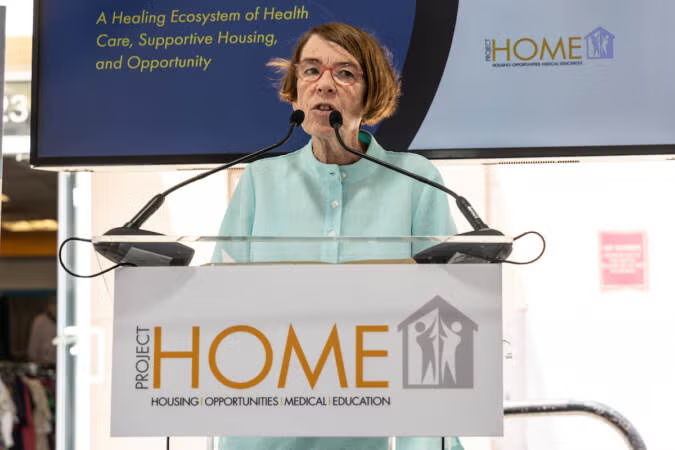
Scullion talked with her frequent collaborator Dr. Richard Wender, chair of Penn’s Department of Family Medicine and Community Health, about ways to address the disconnect between housing and medical care. They also conferred with philanthropist Ira Lubert, a retired tech exec and investment firm manager who has been a longtime supporter of Project HOME, Thomas Jefferson University and other charitable organizations.
In May 2023, Lubert and his wife Pam Estadt announced they would donate $25 million to help create Project HOME’s Recovery and Housing Collaborative along with Penn Medicine, Jefferson and Temple University Health. The goal of the roughly $100 million program would be to provide a “unified ecosystem” of services for people struggling with homelessness, substance use disorder and acute medical issues.
“If we can create a framework that helps us put people on a better trajectory, this initiative will be a success,” Lubert said.
Uber rides, cell phones, ‘translation’ services
A central element of the collaborative is a team of physicians, nurses, social workers, advocates and administrators at each hospital system who look for emergency room patients who meet the program’s guidelines — like Joey Essinger.
“When he popped up on our list, I’m like, I know this person. He’s here all the time. He’s in the ER, and we love him,” recalled Schmus, the Penn Medicine nurse. She and Friedman, her case manager colleague, found him in his emergency room bed. “So there he was, with his broken foot.”
After his fall in the L station, Essinger had spent two weeks getting fixed up at Jefferson Hospital — “they put a couple screws in a metal plate,” he said — before ending up on the street yet again. Living outdoors, in his wheelchair, still using, he had another seizure and was taken to Penn Presbyterian.
Schmus and Friedman asked him if he was “sick and tired” of being homeless, he recalled.
“So I’m like, ‘heck yeah.’ ‘Well, what if we told you we got a spot for you?’ I was like, ‘oh my God.’ I could not believe it. I hugged them both right there in my hospital bed,” he said.

Once a patient agrees to enter the program, they’re assigned to one of the 51 shelter beds reserved for the collaborative at Sacred Heart, the Inn of Amazing Mercy, St. Elizabeth’s Recovery Residence or Prevention Point’s Beacon House. From that moment on, staffers visit them frequently at their shelter, monitor their progress and needs, and provide a host of wraparound services, like Uber rides to doctor’s appointments, help navigating insurance bureaucracies, and “translation” of medical talk, Friedman said
“Once they’re in the environment of the doctor’s office, they can be feeling kind of pretty overwhelmed or overstimulated or anxious because of past experiences,” she said. “So I like to be there to be a second brain and second set of ears to help them remember what they wanted to address.”
It’s transformative for both patients and doctors to have someone like Friedman or Schmus with them during an appointment, Chertok said, for example when complex decisions are being made about whether to operate on a xylazine-related wound. A case manager can help explain how the wound has been treated and how their recovery has been going.
“It’s hard to describe how valuable that is for our patients, but it makes just a tremendous difference, because it’s very intimidating to go to these appointments,” she said.
The participants also get basic life skills help. They’re given cell phones, they relearn how to make their bed and do their laundry, and at some point they typically visit a PennDOT office with Friedman or another case manager to get a new state ID card — a crucial step toward getting government benefits, permanent housing and possibly employment.
“Just helping people navigate being in the world while not using [drugs], people who’ve been very used to thinking in a very concrete, short-term way, because that’s what they needed to do to get through the day: ‘Where am I going to eat? How am I going to have dry clothes or whatnot?’” Friedman said. “Once you have some of those needs taken care of, then you have to figure out how to deal with everything else.”
Working hard to recover
Essinger described his time in the collaborative as “life-changing.”
“They gave me a phone, they gave me clothes. I had nothing. They saved my life, and they are so good to me. I’m so humbled by the stuff they’ve done for me. I feel almost like I didn’t deserve how much they did for me,” he said.
He moved into a dorm-style room at Sacred Heart, underwent physical therapy and, almost four months after his accident, was able to step away from his wheelchair.
“When he first came in here, he couldn’t even walk. [He] worked really hard to get where he’s at,” said Shannon Qualters, assistant program manager at the residence. “You still always see the ones that really want it. He’s definitely one of the ones that really want it.”

His routine now includes regular visits to a methadone clinic, and once a week he spends much of his day in appointments at Penn Medicine, seeing a primary care doctor, another physician, and a therapist.
“I just started talking to my family again. We hadn’t talked in years,” he said. “There’s a lot of stuff going on in their lives too, but… Either way, I’m back in their lives, and they don’t gotta worry right now about getting that phone call that’s every parent’s worst nightmare.”
“The methadone really works with cravings and stuff like that,” he added. “Just the thought of using dope, it makes me cringe. It’s so disgusting.”
He takes care of a tiny turtle named Rupert he inherited from a former Sacred Heart resident, and tries to keep himself occupied and avoid getting bored. He’s waiting to be matched to housing by the city’s coordinated entry system, and thinking about what he’ll do once he has his own place again.
“I can’t wait to get back to work. But I’m gonna start off easy, like 20 hours a week or something. I don’t want to stress myself out,” he said. “I’m not doing any more labor. I’m an old man now. But I’ll find something that’s good for me.”
‘Unbelievable’ progress, but an uncertain future
Other programs serve similar purposes to the Project HOME collaborative, but none appear to match its scope.
For example, medical respite programs like those run by the Public Health Management Corporation in North and West Philadelphia offer a high level of medical care to people experiencing homelessness after they leave the hospital, but typically only for 60 or 90 days.
One direct precursor for the collaborative was Temple Health’s Housing Smart program, which launched in 2020 and initially offered housing subsidies to 25 people. It ran out of funding, but the launch of the collaborative led Temple to create what it calls Home Base teams comprised of housing advocates, community health workers, and recovery specialists, said Patrick Vulgamore, director of Temple’s Addiction Medicine Service Line.
Temple’s program has about 80 patients, he said. Some are part of the Project HOME collaborative, while services for others are funded by health insurance and Temple Health. Vulgamore said the Home Base teams do “amazing work” breaking down silos between different health providers and community organizations, and working together to solve complex problems.
“I have never seen collaboration as close-knit and as patient-focused as this program. It is unbelievable,” he said. “Every single day, it seems like mountains are being moved to get participants what they need.”

At the same time, the collaborative still faces challenges.
While the program has been gradually scaling up toward a goal of 150 beds, there still won’t be enough spots to fully meet the need. Program managers regularly have to turn down hospital staffers’ requests to enroll eligible emergency room patients, Friedman said.
Those who do enroll and stabilize their lives may then have to wait years until the city’s homeless assistance system assigns them to supportive housing or other permanent accommodation.
“It’s very confusing, and there’s a lot of different routes to achieve housing goals, all of which are slow and convoluted,” Gehri said.
The future of the collaborative beyond the five-year duration of the Estadt-Lubert grant is also uncertain.
Managers are exploring whether health insurers will pay for the home nursing supports Schmus and others provide at shelters, which could help fund the program long-term. The federal and state governments could eventually cover more costs, if Pennsylvania follows the example of several other states that have Medicaid waivers allowing providers to bill for home- and community-based services — although the Trump administration has moved to make waivers harder to obtain.
Gehri noted that while the program provides social benefits to the participants and the community, from a healthcare perspective it’s “just really expensive,” spending large sums on a small number of patients. A study is under way to see whether the collaborative cuts emergency hospitalization costs, which could provide an argument for sustained funding of the program.
In the “ideal dream state,” Chertok said, “we could come up with a hodgepodge of grants, as well as billing mechanisms — that would be our goal to sustain what we’re doing.”


